V Care Dental Speciality Clinic, Koramangala: What 615 Google Reviews Reveal About Their Marketing
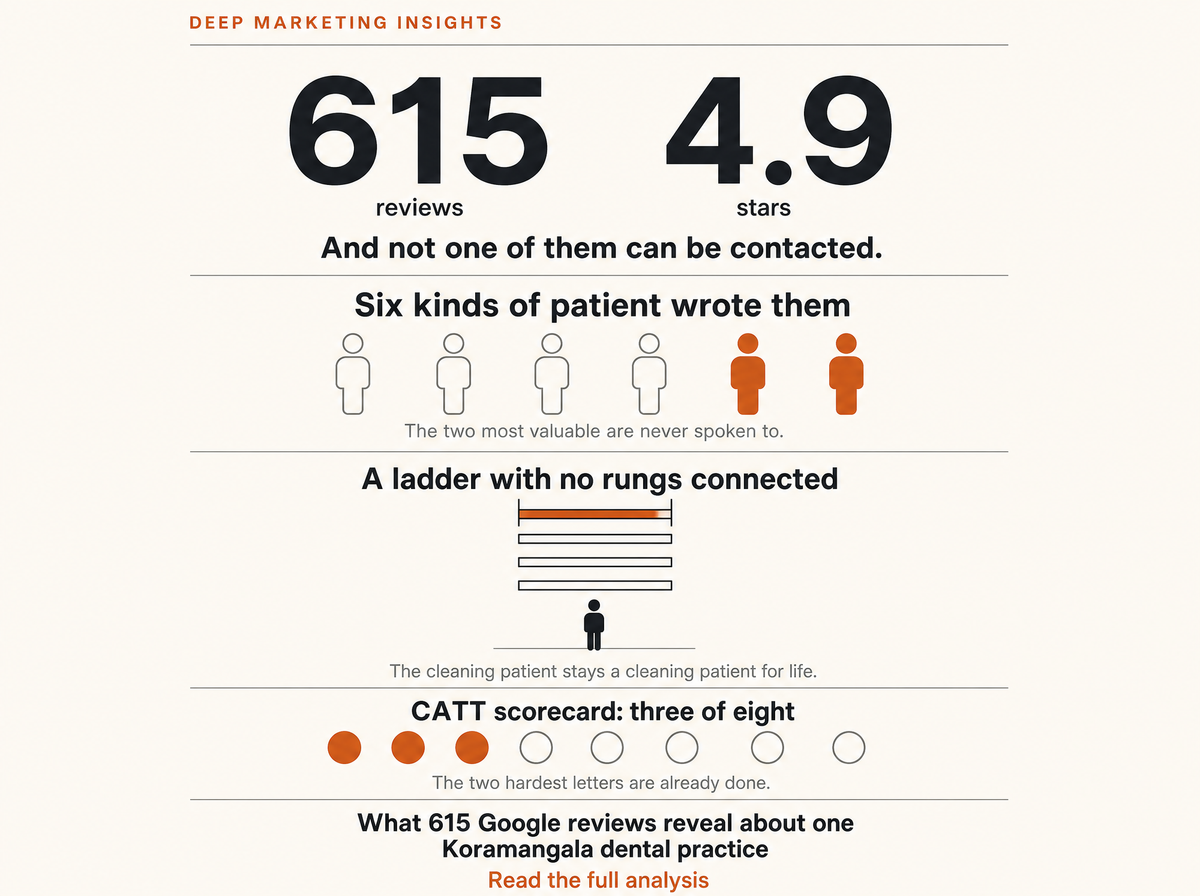
I read every one of them. Six different kinds of patient are writing those reviews, the clinic is selling to one of them, and there is a word in there that nobody at the practice has picked up.
V Care Dental Speciality Clinic in Koramangala holds 4.9 stars across 615 Google reviews. This is a marketer's reading of those reviews. Not a dentist's.
Let me be clear about what I am.
I am not a dentist. I have no opinion on root canals, implants, or whether a milk tooth should be opened in one sitting or three. Ask me and I will give you a confidently wrong answer.
What I do is study how experts get chosen. Doctors, lawyers, architects, consultants. People who are brilliant at a craft and then have to go out and convince strangers of it, which nobody ever trained them to do.
And the most honest place to study that is not a website. A website is what a business says about itself. Anyone can write one. Reviews are what people say when the business is not in the room, and that is the only definition of a brand that has ever mattered.
So I read all 615 of them.
The five findings, in one screen
If you read nothing else, read this.
- They own a word and have not claimed it. Patients keep saying, unprompted, that he does not push treatments you do not need. That is a position. It appears nowhere in the marketing.
- Six different people are writing these reviews. The two most valuable are not being spoken to at all. The loudest one is the cheapest one.
- There is a ladder with no rungs connecting it. The cleaning patient stays a cleaning patient for life. Nobody is deliberately moved anywhere.
- 615 people cannot be contacted. Twenty years of goodwill lives on Google's servers, not the clinic's, and it can be switched off on a Tuesday.
- The two worst reviews are not clinical failures. They are the same failure twice, and it costs one page and ninety seconds to fix.
Everything below is the working.
Start with what they got right, because it is a lot
The rating is 4.9. If you have ever tried to build one of those over six hundred reviews, you know what it costs. Most practices leak a star somewhere in the third year, usually right after they start growing faster than they can deliver.
But the rating is the least interesting thing on the page. Three others are better.
1. There is a face here, not a logo.
Dr. Sanjay Kaul is named in review after review. Not "the clinic was good." His name, spelled out, usually with a thank you attached to it. Go and look at what he is competing against. Chain clinics with pleasant names, clean logos, and no human being anywhere in sight. Nobody hands their money, their health, or their child to a logo. You cannot take a logo to court. You cannot even find out who to ask. V Care has a name on the door and a man behind it, and most of its competition is spending real money trying to buy what he already has.
2. The timelines are ridiculous.
Ten years. Twelve. Fifteen. Eighteen. Twenty. One family mentions coming since 2005. The phrase "our family dentist" shows up again and again, usually with a father, a mother in law, a child and a spouse in the same sentence. That is not patient retention. That is a household making a decision once and then never opening it again.
3. The referral engine is already running.
Read closely and you find a cousin, a friend, a wife's friend, a colleague. People arriving already trusting him, having borrowed somebody else's belief. That is the best kind of patient there is, because the entire long walk from stranger to buyer was done by someone else, for free, on his behalf.
I once asked a student in one of my programmes how he found me. Not an ad, he said. A friend told him about it on a trek, somewhere high up in the mountains where there is no signal, no content, no way for me to reach anybody. That is what reputation actually does. And V Care has clearly been doing it for two decades.
Add a practice that replies to nearly every review, including the furious ones, by name and at length, and you have something genuinely rare.
Which is exactly why the gaps are worth talking about. When a business is at sixty percent, the gaps are obvious. When it is at ninety, the last ten percent is invisible from the inside, and that is where all the money is.
Six different people wrote these reviews
This is the part most practice owners have never done, and it takes an evening.
Everybody talks about "our patients" as though there is one of them. There is not. Read 615 reviews and six distinct people fall out, each arriving for a different reason, each frightened of a different thing, each worth a wildly different amount. The clinic is currently talking to all six in the same voice, which means it is talking to none of them.
| The avatar | What they are really buying | What they are worth | What is missing |
|---|---|---|---|
| The family anchor. Ten to twenty years in. Brings spouse, parents, children. | Not having to decide again. The relief of one fewer thing to research. | Highest lifetime value in the practice. Costs nothing to keep. Refers without being asked. | Nothing is ever sent to them between emergencies. No reason to think of the clinic in a quiet month. |
| The terrified first timer. Put it off for years. Uses the words scared, dread, phobia, anxious. | Relief from fear. The teeth are almost secondary. | Writes the longest and most emotional reviews. Best word of mouth per rupee in the whole list. | Nothing published anywhere that reaches them before they book. They are searching in fear and finding nothing. |
| The caregiver. Booking for a father, a mother, a spouse, a grandmother. | Dignity for someone they love, and to be told they chose well. | Usually attached to the highest ticket work. Dentures, implants, full mouth. | Never addressed directly. Every piece of marketing speaks to the patient, not the person paying and deciding. |
| The anxious parent. Child in the chair. Often an emergency. | Their child not being frightened, and knowing what is happening. | Highest volatility in the practice. Both serious negative reviews come from here. | The explanation arrives after the treatment instead of before it. More on this below. |
| The second opinion refugee. Came from a chain, a failed treatment, or a dentist who refused the case. | Someone who will not do this to them again. | Arrives pre sold. Lowest price sensitivity of any group. Converts fastest. | Completely unaddressed. Nothing on any page speaks to the person who has just been burned. |
| The Maps walk in. Found the clinic on a search, lives nearby, came for the cleaning offer. | A cheap job done nearby. | Lowest value, quickest to leave, and by far the loudest about price. | Nothing moves them up. They came for a cleaning and they stay a cleaning patient forever. |
Three things that table tells you.
- The two best avatars are invisible in the marketing. The caregiver and the second opinion refugee both arrive with money, urgency and almost no resistance. Both are currently found by accident.
- The loudest voice belongs to the least valuable person. The Maps walk in writes about price, and that is what a stranger reads first.
- One avatar produces all the damage. Every serious negative review in 615 comes from the same row. That is not bad luck. That is a design problem with a known location.
Find your six. Then decide which two you are actually building for.
The word they own and have not claimed
Here is the strongest pattern in the whole set, and I would bet the clinic has never counted it.
Over and over, in reviews written years apart by people who have never met, patients say the same thing in their own words. He does not suggest treatments you do not need.
Six ways they phrase it, all of them unprompted.
- He does only what is needed.
- He does not push anything on you.
- No unnecessary procedures, unlike other clinics.
- He discourages intervening too much with the natural tooth.
- Gratitude, in a full paragraph, that most of an original tooth was left alone.
- A direct comparison to a corporate dental chain, saying this is the opposite of that.
Sit with how strange that is.
The loudest fear in this whole category is being upsold by your dentist. Everybody has heard the story about the treatment plan that quietly doubled. And V Care's patients, unpaid and unasked, across twenty years, have elected Dr. Kaul as the one who will not do that to you.
That is a position. A real one. Not a line a consultant workshopped into existence. A belief the market formed on its own and then kept repeating without ever being asked.
Now go and look at how the clinic describes itself. Experienced. Caring. Hygienic. Professional. Latest technology. All true. All completely interchangeable with the next eleven clinics on the same search page. Your buyer has read those words a hundred times. They have stopped meaning anything.
Four reasons this one word is worth more than all of them.
- It is the exact thing the second opinion refugee is searching for. He has just been burned. This is the only sentence he wants to read.
- It is what the caregiver needs before handing over an elderly parent. Not skill. Restraint.
- No competitor can copy it credibly, because it is proven by twenty years of strangers saying it first.
- It is already true, so claiming it costs nothing and risks nothing.
You cannot win by being better. Your patient is not a dentist. He cannot tell who is better and he never will. You win by being different, because different is the only thing he can actually see. "The dentist who will not do what you do not need" is different. "Experienced and caring" is wallpaper.
Go and claim your word.
The ladder that was never built
Now the funnel. Every practice has one whether it was designed or not, and you can read this one straight off the reviews.
| Rung | What it is | Ticket size | Who it pulls in | Where it leads next |
|---|---|---|---|---|
| 1 | Cleaning, polishing, scaling. The advertised offer. | Lowest | Maps walk ins, price comparers | Nowhere. They come back next year for another cleaning. |
| 2 | Fillings, sensitivity, consultation | Low | Walk ins, first timers | Nowhere by design. Sometimes accidentally to rung 3. |
| 3 | Extractions, wisdom teeth | Low to mid | Anxious first timers, referrals | Nowhere. The fear is solved and the relationship stops. |
| 4 | Root canal, crown, cap | Mid | Emergencies, referrals | Occasionally to rung 5, when a tooth fails. |
| 5 | Implants, dentures, full mouth, aligners, veneers | Highest | Caregivers, refugees, long term families | This is the destination. Almost nobody is deliberately sent here. |
Read the fifth column again. That is the whole problem in one line.
There is a ladder here. There are no rungs connecting it. A patient arrives at the bottom, gets an excellent cleaning, and wanders off to live their life. Twelve years later they might need an implant, and by then it is a coin toss whether they remember the name.
Three things follow from that table, and all three are worth money.
1. The cleaning offer is a brilliant front end being used as a product.
A low priced, low risk first step is exactly how you get a stranger to try you. That is what it is for. But a front end has to lead somewhere, and this one does not. The clinic is treating rung one as a small sale instead of as the opening move it actually is.
2. The reputation is compounding at the wrong end of the price list.
The bulk of the 615 reviews are rungs one to four. The rung five work is in there, and it is often the most moving writing on the page. A woman self conscious about missing teeth for years. A twenty two year old terrified of an implant. An elderly father nobody else would treat. Those are the reviews that bring in the next implant patient, and they are buried under a hundred cleanings.
3. The wrong people are setting the price signal.
Look at what the rung one reviewers write about. Affordable. Reasonable. Pocket friendly. Cost effective. The five hundred rupee offer. Lovely people, honestly delighted, and they are the ones publicly pricing this clinic. Somebody researching a full mouth reconstruction lands on that page and quietly files V Care as a good value neighbourhood practice. Which is a compliment, and a ceiling.
Cheap does not just earn you less. It repels the exact people you want, because a patient who cannot judge quality reads the price as a clue. They are not looking for the cheapest help. They are looking for the best help, and price is one of the few signals they have.
This is fixable and it is not a pricing decision. It is a decision about which patient you ask for a review, and when you ask them.
Three more things the reviews know that the marketing does not
1. The 615 most valuable people in this business cannot be reached.
Every one of those reviews lives on Google. Google owns the page, Google decides who sees it, and Google can change the rules on a Tuesday without telling anybody. You have built a fine house on somebody else's land.
But here is the sharper loss. Six hundred and fifteen people liked this practice enough to write about it in public, and there is apparently no way to say anything to a single one of them ever again. You wait for the next toothache. That is the whole plan.
Look back at the ladder. The reason nobody climbs it is not that the patients do not need rung five. It is that there is no channel to walk them there.
Three things that channel would carry, if it existed.
- What to do in the first ten minutes when a child chips a front tooth.
- Why sensitivity gets worse in December, and when it is worth worrying about.
- What an implant actually involves, explained calmly, long before you are frightened enough to ask.
A follower is not yours until you have their email. Neither is a patient.
2. The reviews are a content plan that nobody has read.
Every recurring fear in this set is an article waiting to be written, and it is already written in the patients' own words, which is worth more than anything you could phrase yourself. Seven of them, straight off the page.
- Fear of the injection.
- Fear that the extraction will hurt.
- Fear of being oversold.
- Whether the wisdom tooth really has to come out.
- Whether a milk tooth is worth treating at all when it is going to fall out anyway.
- What flap surgery actually means.
- Whether an implant is safe at twenty two.
Somebody answers all seven, one patient at a time, in a chair, all day, and then goes home. Answered once in public, properly, each one works for years. And it reaches the far bigger crowd who are worried enough to search but not yet worried enough to book.
3. The replies were warmer six years ago.
Small thing. I offer it gently.
The old owner responses read like a person. Short, slightly imperfect, one of them just a thank you and a folded hands emoji. The recent ones are longer, smoother, and built to the same template every single time. Same opening, same middle, same sign off block. Grateful in a way that has stopped being surprising.
They are perfectly professional. But polish and sincerity pull against each other, and readers feel it before they can name it. The clumsy one was doing more work.
The two reviews worth more than the other 613
Now the part I would want to hear if this were mine.
Among 615 reviews there are a handful of unhappy ones. Two involve children in pain. Go back to the avatar table and find the anxious parent, because that is where both of them come from, and it is not a coincidence.
Those two will travel further than all the praise combined, because that is how people are built. We mention a good experience if it happens to come up. We go out of our way to tell everybody about a bad one.
Here is what stopped me, reading them as a marketer and not as a dentist.
In one case the clinic's reply is excellent. It explains that in an acutely infected milk tooth the first visit is an emergency opening to relieve the pressure, that completing the treatment in a single sitting is not advisable while infection is active, and that the rest happens across later visits. Calm, specific, coherent. For all I know, exactly right.
The mother never knew any of that.
She walked in panicking, watched something happen very fast to her child, paid, left, and filled the silence with the worst story available to her. When the clinic followed up about completing the treatment, she read it as a sales call. Then another dentist showed her an X ray she had no way to interpret, and the story set like concrete.
Nothing in that sequence is a clinical failure. It is an expectation that was never set. The explanation existed. It just turned up four months late, in a review reply, to somebody who had already made up her mind.
Every unhappy review here has the same shape.
- A parent did not know the treatment needs three visits.
- A parent did not know anaesthesia can be unreliable in an actively infected tooth.
- A patient booked a cleaning, it took ten minutes, and nobody told them ten minutes can be the correct answer.
One failure, three times. Nobody said the thing beforehand.
Which is oddly good news, because the fix is not better dentistry. Four moves.
- Ninety seconds of script before any paediatric emergency procedure, said to the parent, not the child.
- One page handed over before treatment starts. What we are doing today. What today will not fix. What visit two is for. What it costs.
- A line at reception saying a thorough cleaning sometimes takes ten minutes and sometimes takes forty, and both are normal.
- A follow up that references the plan they were given, so completing the treatment reads as care instead of a sales call.
Do that and most of those reviews are never written.
A good patient refers one. A bad patient warns away ten, and does it louder. That is not a customer service problem. It is the highest return marketing available to this practice, and it costs one page and ninety seconds.
Five things I would do on Monday
Not a strategy document. Five, in order.
- Claim the word. Put "we will not do what you do not need" at the centre of the site, the reception wall, the first consultation. It is already true. It is already believed. It has just never been said out loud.
- Pick two avatars and write to them by name. The caregiver and the second opinion refugee. Both arrive with money and urgency, and neither is being spoken to today.
- Connect one rung of the ladder. Just one. Decide what every cleaning patient hears, and when, that gives them a reason to come back for something other than another cleaning.
- Build something you own. An email list. One useful note a month. Twenty years of trust currently has no address.
- Move the explaining upstream. One page, handed over before treatment starts. Most bad reviews are written by people nobody told.
None of this requires dancing on camera or posting every day. It requires being the same practice you already are, said clearly, to the right people.
Now go and read your own reviews
If you run a practice of your own, here is the whole method. Free, and it will take you an evening.
Open your reviews and answer six questions honestly.
- What word do patients keep using that you have never put in your marketing? That is your position. The market already decided. You just have not read the verdict.
- How many different people are writing your reviews? Build the table. It is never one avatar. It is usually five or six, and you are probably speaking to the cheapest of them.
- Which rung of your ladder are your reviews actually about? That is the price bracket you have been filed under, whether you like it or not.
- Where does a patient go after your cheapest service? If the honest answer is nowhere, you do not have a funnel. You have a queue.
- Can you reach a single one of those reviewers today, without waiting for them to need you? If not, you do not own your audience. You are renting it, and the landlord can evict you.
- In every bad review, was the failure the work, or was it something nobody told them in advance? In my experience it is the second one, about eight times out of ten.
Most experts find their entire marketing strategy in that exercise. It was written for them, by the people who already paid.
The system all of this came from
Nothing above was improvised. It came out of one framework I have used on my own business and on hundreds of expert practices, and it is short enough to write on a napkin.
CATT plus OST equals R.
Content earns Attention. Attention becomes Trust. Trust makes the Transaction. Then Onboarding, Service and Transformation keep the patient and change their life. Do both halves and you get R, your Reputation, which flows back to the start and makes the next patient easier than the last.
Here is where V Care actually stands on it. I think the result will surprise you.
| Letter | What it does | Where V Care stands today | The one move that changes it |
|---|---|---|---|
| C Content | Makes a stranger meet the way you think | Missing. Nothing published anywhere. | Answer the seven questions above, in public, one a week. |
| A Attention | Brings the right eyes to it | Already solved. 615 reviews and twenty years of referrals. Most clinics would pay lakhs for this. | Nothing. Stop worrying about it. |
| T Trust | Turns a watcher into a believer | Built one chair at a time. It works, and it does not scale past the appointment book. | Build it before the chair, not during it. A sequence, not a conversation. |
| T Transaction | Asks, plainly | Never asked. Nobody offers the cleaning patient anything else, ever. | One clear ask, at one clear moment, on one rung. |
| O Onboarding | Makes them certain they chose well | The weakest link, and the source of every bad review. | The one page, handed over before treatment starts. |
| S Service | Keeps the promise | Excellent. That is what 4.9 across 615 means. | Nothing. Protect it. |
| T Transformation | Gets them to the actual result | Delivered, never captured. The best outcomes leave no trace. | Ask for the review at the moment they see the result, not at the counter. |
| R Reputation | Brings the next one | Real, but stranded. Compounding at the cheapest rung, on rented land. | Point it at rung five, and move it somewhere you own. |
Look at that column again. Three of the eight are already done, and two of those three are the hardest ones in the whole framework. Attention takes most experts a decade. Service takes a lifetime. This practice has both.
What is missing is the connective tissue. Four letters, none of them requiring a single new skill, a camera, or a marketing department.
Five things a working CATT loop would fix here, in the order you would feel them.
- The bad reviews mostly stop. Onboarding is the fix, and it is the fastest win on the list. Weeks, not quarters.
- The price conversation changes. When the explanation arrives before the price does, the price stops being a wall. You stop being filed under affordable.
- The cleaning patient starts climbing. A ladder with connected rungs turns a five hundred rupee patient into a rung five patient over years instead of never.
- Implant enquiries arrive warm. The caregiver and the refugee find you having already read you, already convinced, already deciding when rather than whether.
- The practice stops depending on Google. Twenty years of trust finally lives somewhere the practice controls, and it keeps working in the quiet months.
Now, in the spirit of everything I have argued here, let me be honest about what I have just done.
That table is a real diagnosis and it is deliberately incomplete. I have told you which letters are missing. I have not told you what goes in the sequence, in what order, over how many weeks, or how the ask is actually made without sounding like the upselling you have spent twenty years refusing to do. That part is the work.
Which brings me to the only two things I am selling.
About this, and about me
I write these because expert businesses fascinate me. The best practitioner in a market is very often not the busiest one, and the gap between those two people is almost never skill. It is trust, built on purpose or left to chance.
To Dr. Kaul and everyone at V Care, this is written with real admiration. 4.9 across 615 reviews and two decades of families is not something you can fake, buy, or shortcut. Nothing above is a comment on the dentistry. It is a marketer's reading of what your market has already said about you, and what is still lying there unclaimed. If any of it is useful, take it. You owe me nothing for it.
Years ago I came off a motorcycle and cracked a bone. My orthopaedic doctor posted me a get well card. Nothing about my treatment changed. But I have never forgotten him, and I have told that story in a book. That is the whole business, really. The medicine is what they pay for. Being looked after is what they remember.
Now the honest part, since this whole piece has argued that you should ask plainly instead of hinting.
If you want to fill in the four missing letters yourself, the whole system is in my book, Deep Marketing. What content actually earns trust and what just earns applause. How the sequence is built. How the ask is made without ever becoming the pushy salesman you have spent your career not being. Every idea in this analysis came out of it. It is on Amazon here.
If you would rather I did it with you, book a call. We will build your avatar table, your ladder, and your CATT loop against your own reviews, the way I did against these.
And if you would rather just steal the six questions above and do the whole thing yourself over a weekend, do that instead. That is a good outcome too, and it costs you nothing.
Deepak Kanakaraju